Strategy Guides
Quick Pick vs Self-Select: Does the Data Actually Help?
Tags: quick pick, self-select, strategy, due score
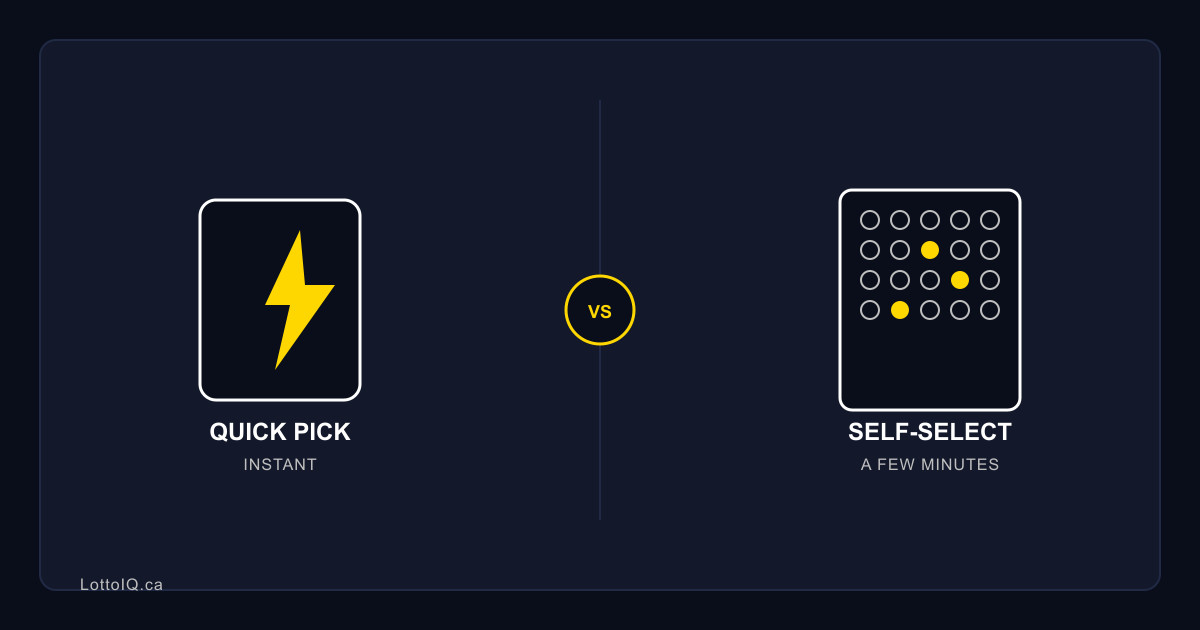
Every lottery terminal in Canada offers the same fork in the road: let the machine generate your numbers (Quick Pick) or fill in the slip yourself (Self-Select). Most tickets sold are Quick Picks, most players default to random rather than think about it. LottoIQ exists for the players who don't. So, it's worth answering honestly: does bringing data into a self-select ticket actually do anything?
What Doesn't Change
Every combination of numbers, no matter how it's generated, has exactly the same probability of being drawn. A Quick Pick generated in half a second and a set built over twenty minutes using Due Score, Pattern Statistics, and Top Number Pairs have identical odds of winning the jackpot. No signal, no filter, no amount of decay-weighted frequency changes that. If a data-driven approach claimed better odds, it would be lying to you, and so would we.
What Actually Changes
Two things shift when you bring data into a self-select ticket, and neither one is your chance of winning.
Process over guesswork. A naive self-select usually means birthdays, anniversaries, or numbers that "feel right." LottoIQ's generator replaces that with structure: sum range, odd/even balance, the overdue signal, cluster affinity, all calibrated against how real draws have actually looked. That doesn't make the numbers more likely to hit. It means every number on the ticket has a reason behind it instead of being pulled from a hunch.
Split-pot risk, not jackpot odds. This is the part with actual financial weight, and it has nothing to do with prediction. Birthday-based picks cluster heavily into 1 through 31, and human number choices lean toward visual patterns on the slip, diagonals, borders, evenly spaced runs. Quick Pick avoids that bias by being genuinely random across the full pool. A data-informed self-select can do the same, or push further, by deliberately including numbers Pattern Statistics shows are historically underused by players, the higher end of the range in Lotto MAX, for instance, even though they're exactly as likely to be drawn as any other number. If a ticket like that ever hits, the difference isn't whether you win. It's whether you split the jackpot four ways or take the whole thing.
Quick Pick vs. Self-Select, Side by Side
| Metric | What Changes |
|---|---|
| Odds of winning the jackpot | Identical across every method, always. |
| Spread across the full pool | Quick Pick: even, random. Naive self-select: clustered into 1–31. Data-informed self-select: even, and can deliberately target underused ranges. |
| Risk of splitting a win | Naive self-select: highest. Quick Pick: average. Data-informed self-select: lowest, if you lean into underused numbers. |
| Time to fill out a ticket | Quick Pick: instant. Naive self-select: quick. Data-informed self-select: a few minutes with the generator. |
| Reason behind each number | Quick Pick: none. Naive self-select: personal or sentimental. Data-informed self-select: grounded in draw history. |
This post is for informational and entertainment purposes only. LottoIQ does not predict lottery outcomes, and no statistical method changes the odds of any individual draw.